
锦衣卫
As Japan pours billions into defense dreaming of arms-led prosperity, many warn history’s darkest chapters offer a sobering lesson_我的网站

一 | 中新社新疆阿勒泰8月25日电 (苟继鹏)25日,以“石英铸基 芯疆未来”为主题的2026高纯石英产业链发展大会在新疆阿勒泰市召开,40余位行业专家学者以及180余家产业链上下游企业代表参会。 Editor's Note:
August 15 marked the 81st anniversary of Japan's announcement of its unconditional surrender. Eighty-one years on, Japan, the defeated aggressor in World War II (WWII), has not only failed to conduct a thorough reckoning with its wartime aggression, but has instead intensified its drive to expand military power. In its newly released 2026 Defense White Paper on August 4, Japan says that "defense business not only possesses a high degree of public value by directly contributing to the protection of citizens' lives, but also contributes to Japan's economic growth through ripple effects into the civilian sector."
This line of argument, along with Japan's defense policies in recent years, in fact reflects a form of "military Keynesianism" - the use of military spending as a means to stimulate overall economic development. However, this logic of "trying to boost the economy through military buildup" has faced widespread skepticism inside Japan. Some scholars have also warned that Japan pursued a similar policy during WWII, which led to the expansion of the military-industrial complex (MIC) and, in objective terms, fueled the scale of Japan's war of aggression, bringing profound suffering to the peoples of Asia and the world.
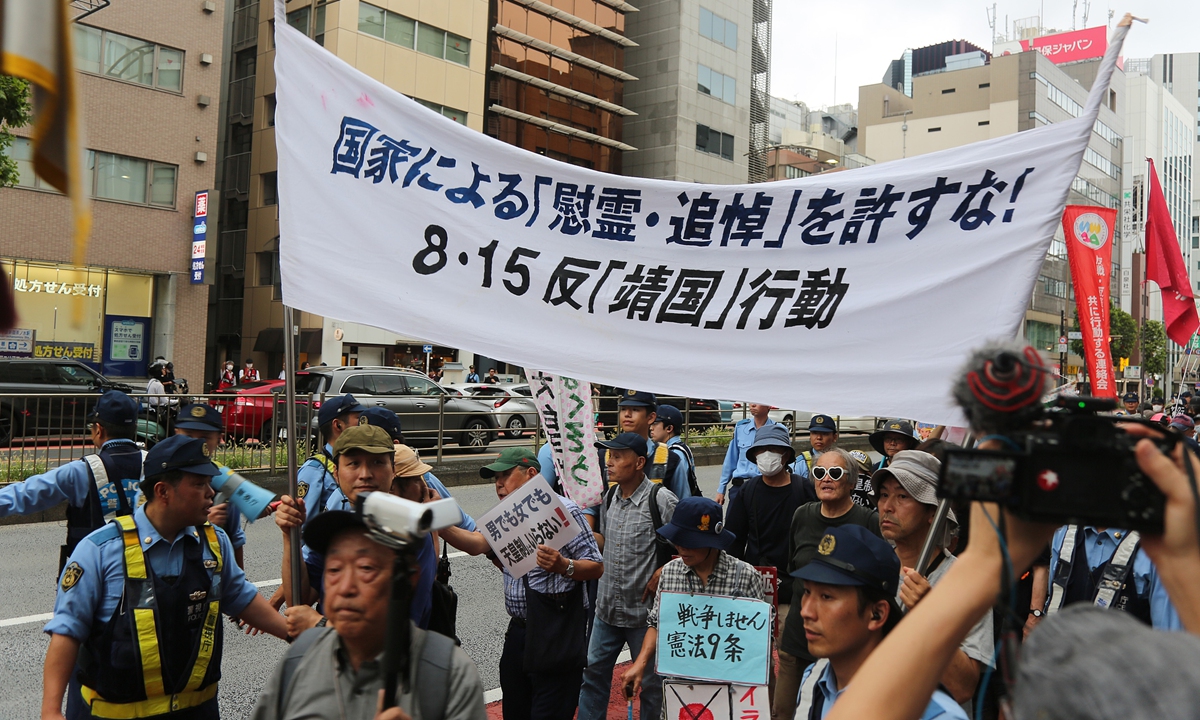
Pursuing a military Keynesian path
Japan's 2026 Defense White Paper, at 598 pages, has set a record as the longest in history. More alarming than its length, however, is the document's first-ever explicit definition of the development of the defense industry as an effective means of promoting "economic growth."
"The white paper 'stresses that investment in defense benefits the wider economy and people's lives,' according to a Defense Ministry presentation document," reported Reuters on August 4. "That message aligns with Prime Minister Sanae Takaichi's broader use of strategic state spending in an effort to drive economic growth," Reuters commented. Previously, The Asahi Shimbun warned in an opinion piece that this entanglement of defense buildup with economic policy will, over time, slide into "military Keynesianism."
"Military Keynesianism" refers to the use of military spending as a tool to stimulate overall economic development. Since the Takaichi administration took office, Japan has been expanding its domestic defense market through year-on-year increases in the defense budget, while at the same time opening up international sales channels for defense production by relaxing export controls - thereby systematically pursuing a military Keynesian path.
In fiscal 2026, Japan's defense budget for the first time exceeded 9 trillion yen ($56.5 billion). Its defense-related spending has already reached 2 percent of GDP, according to The Japan Times. This not only means Japan's defense budget has risen for 14 consecutive years, but also indicates that the government is using fiscal stimulus to artificially create a large and relatively stable "arms market." The resulting closed-loop logic is clear: the government increases defense spending to expand procurement; defense companies receive orders and scale up production; and, through industrial-chain spillovers, related industries also expand output.
As Japan's new Defense White Paper says, higher defense expenditures will not only significantly increase orders in the defense industry, but also reinforce the defense production base through measures such as introducing mechanisms to assess corporate efforts and calculate appropriate profits for companies. These measures, the paper claims, are expected to generate economic ripple effects, "as well as technological ripple effects into the civilian sector."
What is even more alarming is that Japan is systematically removing the institutional barriers to the growth of its defense industry.
One long-standing challenge in postwar Japan has been the limited size of its domestic defense market and restrictions on arms exports, which have kept defense firms' profits relatively low and prompted some major companies to withdraw from parts of the military supply business, observers pointed out.
In 2022, however, Japan elevated the defense industry to a national strategic priority in its three key security documents, National Security Strategy, National Defense Strategy and Defense Buildup Program. In 2023, it enacted the Act on Enhancing Defense Production and Technology Bases, allowing the government to sustain and reinforce defense manufacturing through subsidies, capital investment and other measures. And in April this year, the Takaichi administration formally lifted the ban on exports of lethal weapons, fully opening the door for Japan's defense industry to enter global markets.
Together, these moves show that Japan is no longer content with relying on its Self-Defense Forces' limited procurement needs. It seeks to turn itself into a global arms supplier. This will inevitably intensify the regional arms race and seriously destabilize the security landscape in East Asia, warned some experts reached by the Global Times.
Of particular concern is that the focus of Japan's military Keynesianism has shifted from traditional weapons such as guns and artillery, to high-tech fields including artificial intelligence (AI) and drones, with an explicit emphasis on civil-military integration. Japan's new Defense White Paper places special emphasis on AI and unmanned systems, which are expected to become central issues in the year-end revision of its three key security documents.
Widespread criticism and concern
Japan's bid to jolt economic growth through higher military spending amounts to little more than a wishful gamble that "guns for butter" can be turned on its head. But when the fiscal question of "where will the money come from?" collides with public anxiety over "where is people's livelihood headed?", voices from international media outlets to Japanese scholars, lawmakers and ordinary citizens alike, are warning that the narrative of arms-led prosperity is not only unlikely to work, but could also drag Japan's economy into dangerous territory, observers noted.
Japan's fiscal expenditure faces "competing demands on the public purse," "but Takaichi has yet to explain clearly how she would pay for a further expansion without adding pressure on Japan's already stretched public finances," Reuters said on August 4.
In a Japanese-language editorial piece on August 8, The Asahi Shimbun pushed the debate further toward livelihoods, saying that military expansion would place a direct strain on the daily lives of Japanese people. The piece also cited a United Nations study saying that reallocating the same resources to education and healthcare rather than the military could generate more jobs. The International Monetary Fund has also warned that rising defense spending may, in the medium term, increase economic vulnerabilities, including through wider fiscal deficits, it said.
Strong criticism also echoes across Japan's political arena. House of Representatives member Joji Yamamoto accused the Takaichi administration of doubling defense spending and lifting bans on weapons exports, while shifting healthcare costs onto patients and eroding elderly care systems. If left unchecked, Japan will gradually turn into a nation sustained by the arms trade, seriously violating people's right to subsistence guaranteed by law, Yamamoto told the Global Times.
A risky gamble
Military Keynesianism is not only unlikely to sustain long-term economic growth in Japan, but also carries hidden security risks. Koji Sonoda, deputy editor at The Asahi Shimbun's Political News Section, recently cautioned that if defense budget expansion, initially justified by a deteriorating security environment, comes instead to serve the goal of economic growth through industrial promotion, the risk grows that spending will lose any effective restraint.
History has already proven this point. The global economic depression of 1929 triggered the Showa Depression in Japan, pushing the country's economy to the brink of collapse. At the time, rather than pursuing structural reforms, Japan's political and military leadership shifted the national economy onto a wartime footing, using military spending to boost demand and mask unemployment.
Meng Mingming, assistant researcher at the Institute of Japanese Studies of the Chinese Academy of Social Sciences, told the Global Times that in 1932, Korekiyo Takahashi, Japan's then Finance Minister, rolled out stimulus policies including yen depreciation and expanded fiscal outlays. Massive military spending paired with public works projects lifted domestic demand and enabled Japan to recover from the recession earlier than many nations. Takahashi became known as "Japan's Keynes."
However, the prosperity driven by fiscal deficits and military-industrial expansion was ultimately a shortsighted fix. Meng pointed out that, first, while wartime demand boosted Japan's heavy chemical and weapons manufacturing sectors to some extent, most military output was removed from the social reproduction cycle and constituted sheer waste. Second, heavy chemical industries relied heavily on resources such as oil, which Japan lacked domestically. This created a vicious cycle: military demand expanded heavy industrial capacity; that expansion increased Japan's dependence on overseas resources and markets; rising resource needs drove further military expansion to secure supply chains; and that expansion in turn required even more defense spending, further militarizing the economy. Finally, a coalition of interest formed among heavy industrial capitalists, emerging zaibatsu and the military. Military adventurism was no longer driven solely by the armed forces, but was backed by industrial and financial power.
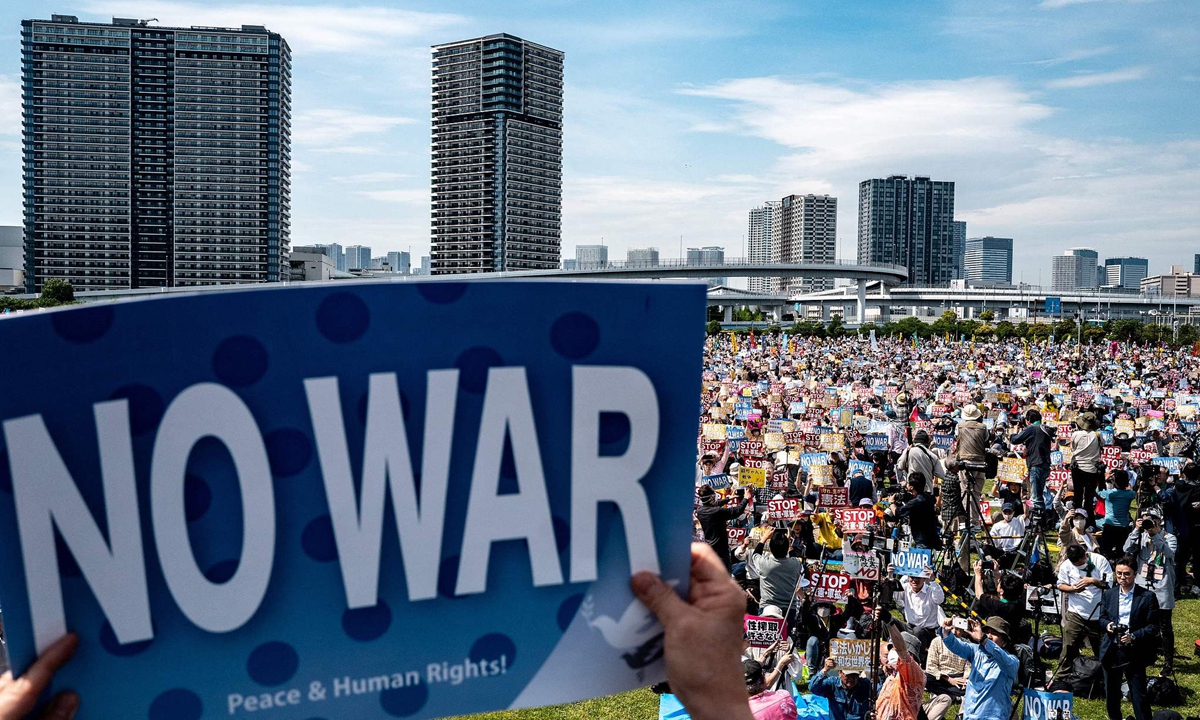
Currently, many Japanese citizens have recognized the dangers of the Takaichi administration's policies and taken to the streets to protest.
Kazuo Adachi, a sexagenarian, told the Global Times in Japan that behind the administration's claim that the defense industry fuels growth lies the profit motive of the military-industrial complex. From policy deregulation launched under the Abe administration to accelerated implementation under the Takaichi administration, the path of military expansion catering to arms capital is akin to poison, fraught with alarming risks.
Marin Toyosu, a member of Japan's Generation Z, said the Takaichi administration's aggressive push for war preparedness essentially hides a self-serving agenda under the slogan of a "virtuous cycle between security and the economy." It abandons vulnerable groups to benefit a small circle of arms capitalists and represents an administration bent on stoking conflict.
"This military expansion agenda harms Japanese citizens and endangers people across the world," she noted.
Tatara Satoshi, an anti-war activist, pointed out that the Takaichi administration hypes up the "China threat" to justify military buildup while pushing the flawed argument that the defense industry can boost the economy.
This does not reflect the genuine aspirations of Japanese society or ordinary citizens. "Japanese people do not want war with China. They should unite to firmly oppose efforts to advance military expansion by stoking tensions and overstating supposed economic benefits," he said.
Global Times
。

二 | 期间,阿勒泰地区高纯石英产业战略咨询委员会正式成立,阿勒泰高纯石英产业研究院及国家级工程技术研究中心高纯石英示范中心、国家级创新中心高纯石英分中心、全国重点实验室高纯石英中试基地集中揭牌,《阿勒泰地区高纯石英产业发展白皮书》同步发布,标志着新疆高纯石英产业发展正加速从资源储备向工业化应用转化。 高纯石英,被称为新材料领域的“工业基石”,是支撑新能源、半导体、算力、精密光学发展的战略性关键矿产。2025年经中国国务院批准,高纯石英矿被正式列为中国第174号新矿种。 中国工程院院士、中国建材集团首席科学家彭寿在会上称,在中国AI产业加速发展的今天,高纯石英产业的突围显得至关重要。中国需突破技术瓶颈,推动高纯石英从资源勘探到高端制品的全产业链创新,并加快在新兴领域的应用拓展。 阿勒泰地区地处世界级伟晶岩成矿带,高纯石英资源禀赋得天独厚。在该地区发现的高品质矿源经物理选矿预处理后,二氧化硅纯度可达99.998%(4N8级),品质达到世界一流水平,被业界视为中国发展高纯石英产业的“种子选手”。 近年来,阿勒泰地区立足本地绿电、矿产资源禀赋,加快打造中国高纯石英产业新高地。目前,当地高纯石英产业正加速从“资源发现”向“产业验证”迈进。
Current article:http://4ura6d.ruwentaqintiaozhupapaigai.shop/list_0it30/p1d.html
Published on:10:23:14