
银魂
Climate Gambit: Chinese team develops ‘super brain’ to guide flood precautions using weather, hydraulic and terrain data_我的网站

一 | TOPEKA, Kan. -- Child welfare officials investigated the family of a 5-year-old Kansas girl five times in the 13 months before she was raped and killed, but couldn't confirm allegations of neglect or drug use by her mother, and the family repeatedly declined offers of help, a report released Tuesday showed. The report by the state Department of Children and Families said in one case, the agency confirmed that the mother wasn't properly supervising Zoey Felix, but the girl was placed with her father and because of that, “No safety concerns were identified.” After receiving allegations in late August of drug use and lack of utilities in the home, child welfare officials made seven failed attempts to reach the family over the next month.On Oct. 2, Zoey died after fire crews couldn't resuscitate her at a gas station. Neighbors believe Zoey and her father had been camping in a grove of trees on a vacant lot nearby. Mickel Cherry, a 25-year-old homeless man, is charged with first-degree murder, rape and capital murder, and could face the death penalty. Authorities haven't said how Zoey died. “Zoey Felix’s death was an unacceptable tragedy," Gov. Laura Kelly said in a statement accompanying the Department of Children and Families' two-page summary of its interactions with the girl's family. Kelly said she plans to push for legislation next year that would expedite the release of information when a child dies of abuse or neglect. Her administration pushed for such a change in 2021, but a bill never passed. Currently, DCF only releases a summary of its involvement initially and can't do so until attorneys vet the document. Typically, the full case reports aren’t released until after the prosecution is completed, which can take well over a year.This has left an information vacuum in Zoey's case that was exacerbated Tuesday when a judge sealed the arrest affidavit that was used to support criminal charges against Cherry. Judge Christopher Turner concluded that releasing the records would jeopardize the safety of witnesses or sources or “cause the destruction of evidence.”Cherry’s attorney, Mark Manna, of the Kansas Death Penalty Defense Unit, has declined to comment. Cherry’s family didn’t respond to phone messages, and his Facebook friends described him as chronically homeless. Neighbors said Zoey wandered their neighborhood dirty and hungry. Several reported calling child welfare to express concerns. According to the summary from DCF, child welfare officials said they received the first tip about Zoey on Sept. 8, 2022, alleging poor conditions in the home and possible drug use in the presence of a child. The mother agreed to a drug screen and it came back negative, the agency said. The agency also said in its summary that Zoey's mother was working with court services. By then, she had been charged with domestic battery against her husband and teenage daughter, court records show. The DCF summary said the agency offered help to the family, but they declined and the case was closed. Another complaint alleging an unsupervised child was lodged with the agency on Nov. 8, 2002. Just six days earlier, Zoey's mother had called to report that the then 4-year-old was missing, a police incident report shows. Zoey was found unharmed a short time later.The DCF summary made no reference to Zoey's disappearance, and it was unclear whether that prompted the complaint. The summary said simply that the case was unsubstantiated and offers of help were denied. Later that month, Zoey's mother was arrested after crashing her car near a north Topeka bar while driving drunk with Zoey in the front seat. A sworn statement from a Topeka police officer, which also was released Tuesday, said the mother was “having difficulty standing upright, attempting to walk away with a small child.” He also wrote that in looking into her car, he saw two open bottles of vodka, one half-full and the other, three-quarters full. The officer said that in interviews, Zoey said her mother had been drinking from both bottles before and while driving.The officer wrote that the mother was uncooperative and, “She was taken to the ground in order to be handcuffed.”The DCF summary said welfare workers left Zoey in her father’s care; court records show he was living with a girlfriend at the time. Zoey's mother was jailed until March, when she pleaded guilty to felony aggravated battery and driving under the influence and was sentenced to probation. Zoey's father was evicted from his apartment in May. Another tip the agency received that month alleged there were no operating utilities in the mother's home, but the agency found the home to be “livable," with utilities, food and no signs of drugs. Again, the family declined services. Then on Aug. 29, another complaint alleged drug use and no utilities, prompting the seven failed attempts by the agency to contact the family in September. But during that time, police went to the home twice, once even tracking down Zoey and talking to her. But officers were told by Zoey’s father that she wasn’t living there, city spokeswoman Gretchen Spiker said. The second time police responded, an officer stood outside as belongings were retrieved from the house, a police report said. Police reports do not explain where Zoey, her sister, her father and Cherry went after that, but neighbors said they were living in a makeshift camp.Laura Howard, the top administrator for the Department for Children and Families, vowed to launch a thorough investigation.“We will take every step necessary," she wrote in a statement. DCF opened another investigation as a result of Zoey’s death.。
Extreme weather is increasingly a global challenge, and the key to addressing climate risks lies in earlier prediction, more precise action and smarter preparedness, with emerging technologies playing a vital role. The Global Times launches the "Climate Gambit" series, exploring how research teams are leveraging cutting-edge technologies, including artificial intelligence, high-performance computing and smart observation systems, to anticipate weather changes, enhance disaster early-warning and strengthen resilience against climate risks.
Inside a state key laboratory at Xi'an University of Technology, Northwest China's Shaanxi Province, there is a miniature but complete "water world" which simulated water channels, inland lakes and main rivers to recreate real flood scenarios and test their newly developed GPU Accelerated Surface Water Flow and Transport Model (GAST).
Known as a "super brain" for flood control, GAST can complete flood simulations involving more than 3 million computational units within 30 seconds, helping transform flood management from a reaction to emergency into active precautions since "flooding impacts can be predicted even before rainfall arrives."
At a time when extreme rainfall and summer flooding have become increasingly frequent, questions such as when the flooding will arrive, which roads may be submerged and when residents should evacuate have become increasingly important.
In an exclusive interview with the Global Times, Hou Jingming, a professor at Xi'an University of Technology and the leader of the research team, explained how the GAST model seeks to answer these questions by accurately predicting flood development and identifying vulnerable areas before disasters occur, and how the model helps authorities take preventive measures to reduce casualties and economic losses.
AI empowering 'flood drill'
The water tank system in the lab was designed to create a controllable, repeatable and observable environment to simulate complex hydrological processes, including river flooding, urban water level changes, lake regulation, drainage pump operations and coordinated flood-control measures.
By adjusting variations such as upstream water inflow, rainfall intensity, downstream water levels and drainage conditions, scientists can recreate different flood scenarios. Meanwhile, water levels, flow speeds and other data are collected in real time and displayed on a digital twin platform.
"If a rainstorm and corresponding floods are an exam, GAST is like a 'drill,'" Hou said. "It can simulate how floods develop, where water will flow, which areas may be inundated and when river levels may rise, ensuring authorities are well but not overly prepared."
To answer the public's concern about "whether my neighborhood will be flooded when heavy rain arrives," the team developed new algorithms for urban surface water flow, including improvements in terrain slope and friction calculations.
These breakthroughs have improved simulation accuracy in complex urban environments. Compared with extensive monitoring data, GAST can keep simulation errors of key hydrodynamic factors within 15 percent. This means the model can provide not only general flood trends, but also quantitative information such as water depth, flow speed and inundation areas.
Combined with AI technologies, it can identify complex relationships between rainfall, water conditions, flood depth, flow velocity and affected areas, cutting simulations from hours in traditional methods to minutes or even seconds.
The faster calculation capability means that once meteorological authorities update forecasts, the model can quickly estimate flood risks in different parts of a city.
"The earlier rainfall warnings are issued, the earlier we can identify potential flooding hotspots and high-risk areas," Hou said. "This saves valuable time for evacuation, traffic management and emergency deployment."
For smarter disaster response
Building an accurate flood prediction model also requires integrating large amounts of urban data other than weather forecasts, including urban terrain, drainage networks and infrastructure information.
For example, a model developed for Xi'an incorporates geographic data and drainage system information collected from relevant authorities and field surveys. After receiving rainfall forecasts, the system can quickly calculate possible flooding scenarios, showing when and where waterlogging may occur and highlighting vulnerable roads and areas through visual maps.
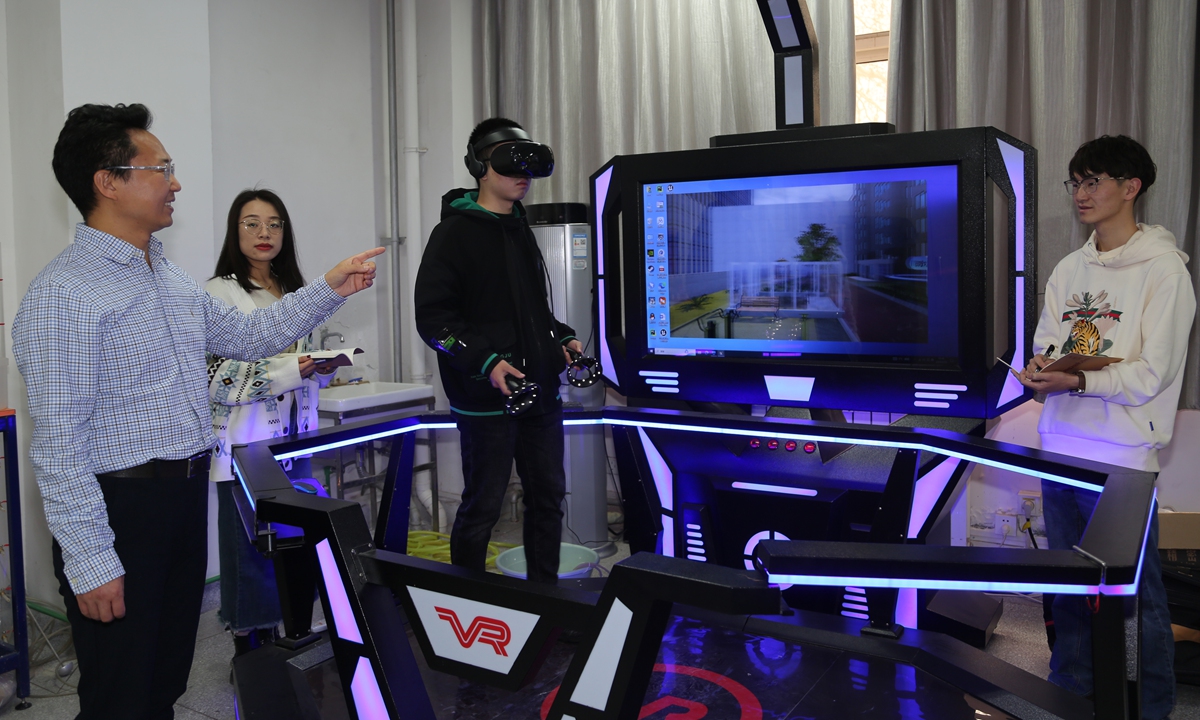
To demonstrate how the super brain works in case of possible flooding, the laboratory has set a virtual reality area where visitors can experience a simulated urban flooding evacuation in the Xiaozhai area of Xi'an. Wearing VR headsets, participants can see water levels gradually rising and follow emergency instructions to move toward higher ground.
The entire technological package has already been applied in real-world flood prevention.

During Typhoon Muifa in 2022, Haishu district in Ningbo, East China's Zhejiang Province, recorded a regional rainfall of 367 millimeters. Using GAST as its core technology, the local flood forecasting platform integrated weather forecasts, AI algorithms and real-time monitoring data to provide rolling three-hour flood risk predictions.
Post-event assessments showed that predicted risks at most locations matched actual flooding conditions. The average relative error between predicted and observed maximum water depths was 13 percent.
The GAST model was also integrated into a smart rain and flood management platform in Qinhan new city area in Xianyang of Shaanxi, and during a rainstorm warning in July 2022, the platform provided continuous monitoring and forecasts. Based on the results, local authorities shifted from routine inspections to targeted monitoring of flood-prone areas and optimized emergency drainage operations.
The model is also being applied to mountain torrent prevention, as it can simulate rapidly changing flows in complex terrain and, combined with machine learning, complete forecasts within seconds. For reservoirs and rivers, it supports sudden and gradual dam-break simulations.
In June 2026, the model was presented at a national symposium on flood risk mapping achievements. The technology has since been applied by water resources, emergency management and urban development authorities, expanding from Shaanxi to multiple provinces and regions across China.
Looking ahead, the research team is developing a framework that further keeps up with the pace focusing on AI technologies. "Currently, the system operates based on weather forecast, therefore, AI will increase efficiency by using historical cases and real-time monitoring data to correct errors and update forecasts dynamically," Hou said.
。
Current article:http://4ura6d.ruwentaqintiaozhupapaigai.shop/list_yle/z1t4.html
Published on:00:57:55